Overview
The Product List view in MioSalon provides a centralized place to manage all products, track inventory, and monitor product consumption. From this screen, you can view products by category, track stock levels, filter products by type, and configure how product consumption is recorded at store or staff level.
Products are classified as Internal Products or Retail Products, helping businesses clearly separate products used internally from those sold to customers.
To access the Product List
Log in to your MioSalon account.
From the left-side menu, click Settings.
Scroll down to Module Settings and click Product.
By default, the Product List tab is selected.
You can now view, filter, and manage all products.
Understanding Product Consumption Tracking
At the top of the Product List, MioSalon explains how product consumption is tracked.
Product Consumption Levels
Store Level
Product consumption can be tracked automatically or manually.
By default, consumption is tracked automatically when products are linked to services.Staff Level
Product consumption is tracked automatically based on staff service usage.
Note:
To track consumption automatically, the product must be tagged to at least one service.
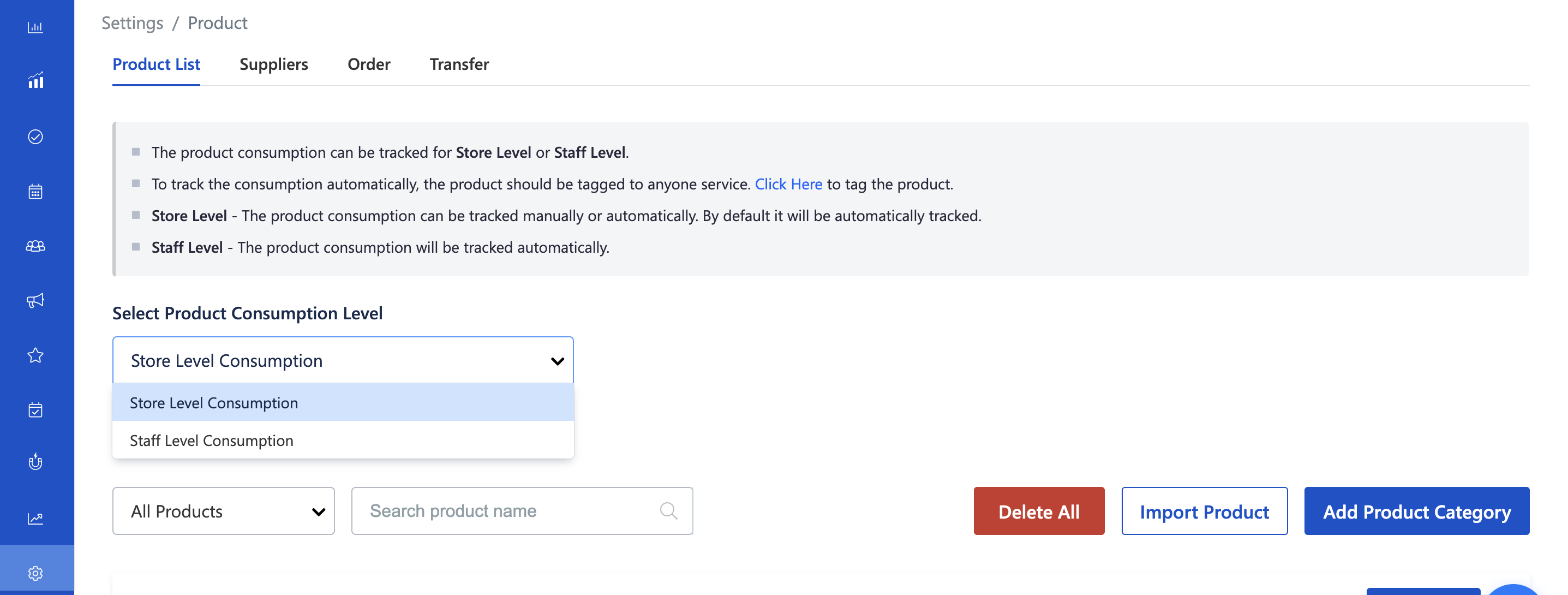
Select Product Consumption Level
From Select Product Consumption Level, choose:
Store Level Consumption, or
Staff Level Consumption
If Store Level is selected, you can optionally enable Enable product consumption manually.
This controls how inventory is deducted during service delivery.
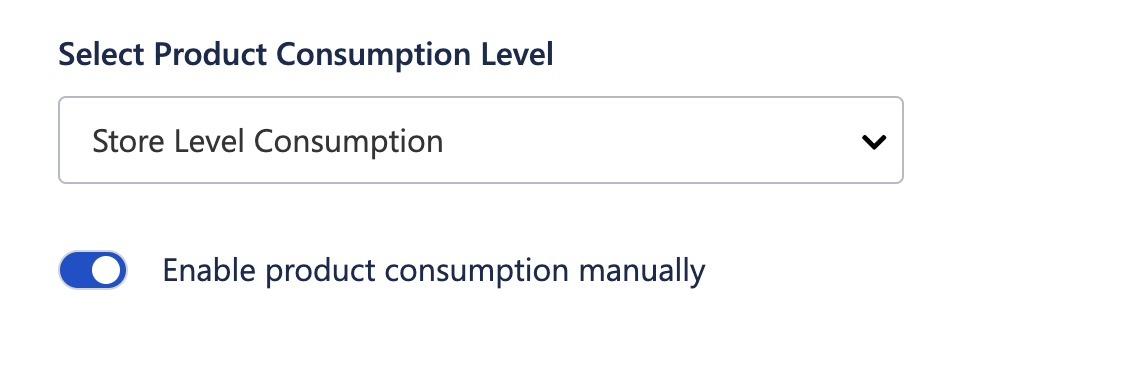
When to enable manual product consumption?
Enable this option when product usage varies per service or customer and staff need to record the actual quantity consumed, ensuring more accurate inventory tracking and better control over high-value products.
Product Filters and Classification
Product Type Filter
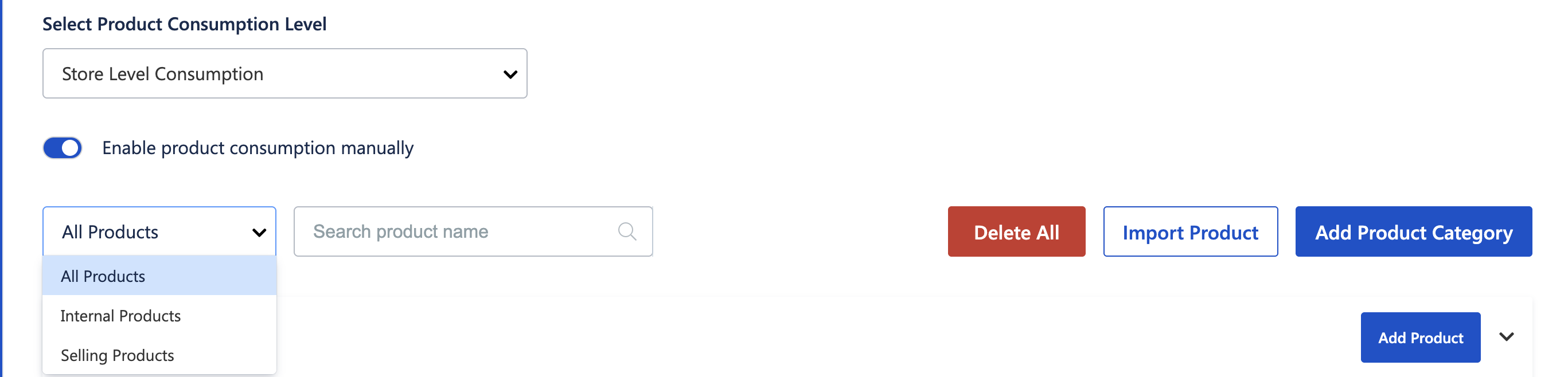
The Product Type filter allows you to classify and view products based on their usage.
Available filter options:
All Products
Displays every product in the system.Internal Products
Products used internally for services (e.g., shampoo, color, creams).
These products are consumed during services and are not sold directly to customers.Selling Products
Products sold directly to customers as retail items and tracked through billing.
Product List View Details
For each product, the list displays:
Product name
SKU / Barcode
Price
Stock on hand (Qty)
Total volume
Stock history (View link)
Products are grouped under Product Categories, with options to:
Add Product
Edit Product Category
Expand or collapse category sections
Important Notes
Internal Products affect inventory through service consumption.
Retail (saleable) Products affect inventory through billing.
Consumption rules depend on the selected consumption level (Store or Staff).
Stock history provides a complete audit trail of inventory movement.
Filters do not change product behavior—only the view.
Use Cases
Inventory clarity
Separate internal-use products from retail-selling products.Retail stock tracking
Monitor stock levels for products sold to customers.Service consumption accuracy
Automatically deduct internal product usage during services.Operational control
Switch between Store Level and Staff Level consumption tracking.Faster product management
Filter products quickly instead of scanning long product lists.
Related Articles
Was this article helpful?
That’s Great!
Thank you for your feedback
Sorry! We couldn't be helpful
Thank you for your feedback
Feedback sent
We appreciate your effort and will try to fix the article